Settings
 Fast Delivery
 Free Shipping
 Incoterms
 Payment Types


 Marketplace Product

omniCOOL: Introducing a Unique Approach to Fan Design
2018-03-08
The rise of IoT and Cloud data services has put data centers, housing powerful servers and storage devices at the forefront of the electronics industry. It is also a well-known fact that these data centers generate enormous amounts of heat, which has to be removed from critical equipment—a task that usually starts with a fan.
The same holds true for other applications that we depend on. Products such as home computers, household appliances, and industrial machinery will only function reliably if they are kept within a specified temperature range. In other words, fans play an incredibly important role in modern life.
The sleeve bearing vs. ball bearing trade-off
At the core of every fan is the bearing. This critical component enables the fan rotor to turn and is key in determining a fan’s operational life, making it crucial for designers and engineers to choose the right fan bearing to cool their application.
Traditionally, this choice has been between a fan with a sleeve bearing and one with a ball bearing. Both have their strengths but picking one over the other will usually result in a trade-off somewhere along the line. This is why Same Sky has taken a new approach to bearing design that bridges the gap between ball and sleeve versions.
However, before we look at how this new fan design works, we must first review the benefits and shortcomings of the more traditional sleeve and ball bearing types.
Understanding sleeve bearings
The shaft at the center of sleeve bearing fans spins inside a “sleeve-like” cylinder with a layer of oil lining the sleeve that enables the shaft to turn. The sleeve’s role is to hold the rotor in the right position, making sure it is always the correct distance from the motor stator (Figure 1). Sleeve bearings are the more cost-effective of the two traditional designs and will hold-up better in applications that experience shock and vibration. However, its design does hold several drawbacks.
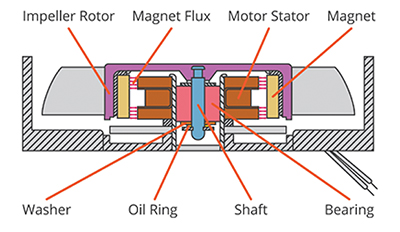 Figure 1: Diagram of a typical sleeve bearing fan (Image source: Same Sky)
To minimize rotor wobble, the sleeve needs to fit snugly around the shaft, but the greater this contact area is, the more friction you have to overcome and the longer it takes to start the fan. This means more energy is required, both to start the fan and to keep it spinning.
Another issue with the sleeve design is the weight of the rotor is supported solely by the shaft in the sleeve. Consequently, as it rotates, it gradually wears down the inside of the bearing, distorting the shape of the bore. If your fan is always used in the same orientation, an oval-shaped sleeve cross-section will begin to develop, which may make the fan noisier and cause it to wobble.
This bearing wear problem can be worse if your fan is required to operate at different angles, as could be the case with portable equipment. With gravity pulling the rotor’s mass in different directions, depending on the angle of use, the sleeve will wear unevenly, which can exacerbate the wobble and noise problems.
Ultimately, this wear shortens the life of the bearing and, depending on your design, possibly the whole fan unit or even the product it is cooling.
Furthermore, the lubricant mentioned earlier that is required to keep everything rotating is typically provided by including an oil ring and Mylar washer at both ends of the bearing bore. These components are intended to combat friction, but the reality is their presence adds to it. In addition, their positioning makes it harder for the gases generated by rotational friction to escape. If these gases cannot dissipate, they turn into solid nitride particles, which clog up the bearing, hampering rotation and shortening its life.
The basics of ball bearings
Fans with ball bearings (Figure 2) typically have two rings of little steel balls surrounding the shaft, one closer to the rotor than the other. A ring of springs presses them apart. This setup helps tackle the issues of rotor tilt and uneven wear that you get with sleeve bearings. The reason for this is that the rotor’s weight rests on the ball bearing closest to the rotor itself, but the springs help offset any tilt that might occur as a result of gravity pulling down on the rotor. This means a fan with ball bearings can be used at any angle, making this design a superior choice for portable devices. The reduced bearing wear also means your mean time between failures (MTBF) will typically be much higher with a ball bearing-based design rather than with a sleeve variant.
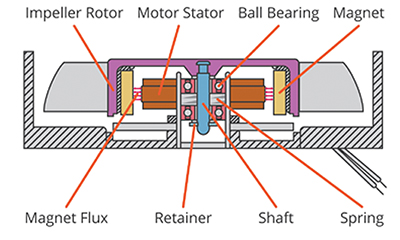 Figure 2: Diagram of a typical ball bearing fan (Image source: Same Sky)
While ball bearings reduce the amount of friction you must overcome to start and operate your fan motor, they are costlier, noisier, more complex and less impact-resistant than sleeve bearings.
omniCOOL™ system: Bridging the gap
To minimize the need for designers to make tradeoffs when specifying a fan, Same Sky omniCOOL™ system found in its line of advanced sleeve bearing fans, seeks to bridge the cost-performance gap and extend fan life by incorporating either a magnetic rotor-balancing structure or an enhanced sleeve bearing.
 Figure 3: Diagram of Same Sky omniCOOL system (Image source: Same Sky)
DC fans with the omniCOOL system that utilize the magnetic structure design include a “-V” suffix on respective part numbers. Thanks to the magnetic structure (Figure 3), the rotor effectively becomes a spinning top that never falls over and can work at any angle. This is because the system’s magnetic structure sits in front of the rotor and uniformly attracts it all the way around, no matter what angle the fan is operating.
A supporting cap at the tip of the shaft keeps it in place, forming the point around which the rotor spins, just like the point on a spinning top.
This approach, using the magnetic structure, means the rotor weight is not borne by the bearing sleeve, but by magnetic forces, which suspend the rotor in the air. This cuts down the friction between the inside of the bearing and the shaft. It also reduces the tilt and wobble problems found with traditional sleeve bearings. Testing shows that this magnetic structure leads to a significantly longer expected operating life than a traditional sleeve bearing (Figure 4).
 Figure 4: Comparing life expectancy of a traditional sleeve bearing and the omniCOOL system's magnetic structure. (Image source: Same Sky)
Alternately, present on fans with a “-C” or “-CF” suffix on the model number, the omniCOOL system utilizes specialized grooves on the outside of the bearing to promote the circulation of lubricant around the shaft. This improved lubrication leads to friction reduction and thus a longer cycle life. While the life expectancy gains are certainly an improvement over traditional sleeve bearings, they are not as significant as the -V magnetic structure fans, as shown in the testing results in Figure 5. However, the -C and -CF enhanced bearing fans are a more economical option.
 Figure 5: Comparing life expectancy of a traditional sleeve bearing and the omniCOOL system’s enhanced bearing. (Image source: Same Sky)
A new alternative to traditional fan designs
The alternate technologies found in the omniCOOL system bridge the gap between ball and sleeve bearings, providing a quiet, strong, long-lasting fans that are more cost-effective than ball bearing designs. For engineers, it provides a new alternative to cool electronic equipment without the traditional tradeoffs.
View Same Sky line of DC axial fans and blowers with the omniCOOL system.
Disclaimer: The opinions, beliefs, and viewpoints expressed by the various authors and/or forum participants on this website do not necessarily reflect the opinions, beliefs, and viewpoints of DigiKey or official policies of DigiKey.