Settings
 Fast Delivery
 Free Shipping
 Incoterms
 Payment Types


 Marketplace Product


Use Board-Mount Converters to Meet Isolated and Non-Isolated AC/DC and DC/DC Power Requirements
A modern power-distribution arrangement often requires a sophisticated combination of isolated and non-isolated AC/DC and DC/DC power converters. The isolated converters are primarily required for system and user protection in the event of single or multiple faults; they are also needed to power isolated subfunctions to maintain signal integrity.
In principle, you can readily design your own low-to-moderate-power converter (up to around 1000 watts) using sophisticated ICs, with different architectures offering various performance trade-offs. However, the reality of developing and validating these converters is a different story. You must, at the very least, meet a basic set of functional-performance requirements, including output voltage and current ratings, efficiency, transient response, physical size, and protection against line, load, and supply faults.
The design challenge doesn’t stop with just the basics. There are lists of regulatory mandates covering safety, efficiency at different load levels, shutdown performance, thermal performance, and electromagnetic interference (EMI) emissions and susceptibility, among others. These attributes must be verified by a certified testing lab, adding significantly to the design timeline. The simple do-it-yourself (DIY) option soon becomes very risky, and you’ll quickly find the make-versus-buy decision leans heavily toward buy.
If you’re not convinced, consider that the converter must also include galvanic isolation. While a common requirement for nearly all AC/DC converters, it is also needed for some DC/DC converters. This need introduces new regulatory, safety, and certification mandates, further tilting the make-versus-buy decision toward buy, regardless of supply size.
The good news is that board-mounted isolated and non-isolated power converters are available in a wide range of voltage and current ratings. These greatly simplify the design and deployment of products for applications in defense, communications, and test and measurement (isolated) and mobile robotics (non-isolated), and can be used in combination for power distribution.
As drop-in components, they can be placed on the main printed circuit board (pc board) in a location optimized for the power-distribution rails. In addition, they don’t need discrete supports or brackets. In short, they provide the power function as a closed, complete, ready-to-go solution.
Isolation basics
Galvanic isolation is an electrical barrier that prevents a conductive (“ohmic”) path from forming between two sides of a signal or power path. However, this isolation must still allow energy and power to pass through using other transfer methods. Isolation may be needed for signals, power, or both, depending on the design. The techniques used to implement isolation depend on the specifics of the current flow that is being isolated.
You may need isolation for several reasons. For signals, it can improve sensor integrity, eliminate ground loops, or protect users and circuitry in the event of faults that allow power to flow into signal paths.
For power, it is primarily needed to ensure user safety and to prevent shock from inadvertent contact with AC power lines or high-voltage DC power. It also supports the needs of “floating” circuitry (no connection to circuit Earth ground) used for non-power signals.
In general, isolation is a method for routing current flow in accordance with Kirchhoff's Current Law (KCL). For any current to flow, there must be a return path back to the source, and the role of isolation is to break this path. In a potential electric-shock scenario, the complete fault-current path through the user and back to ground (Figure 1, left) is broken by the isolation transformer in the power source (Figure 1, right).
 Figure 1 : To prevent electric shock, the fault-current path through the user and back to ground (left) is broken by the isolation transformer in the power source (right). (Image source: Lumen Learning)
In one common potential-shock scenario, frayed insulation allows a live/hot power wire to come into direct contact with the appliance's metal case. Even though the appliance may still operate as intended, the user could be shocked if the Earth/ground connection is broken (as is often the case) and fault current flows through the user to ground rather than safely through the ground wire.
To manage this risk, the isolation function in the power supply breaks the current path between the original voltage source and the device. This prevents a circuit from forming between them, thereby eliminating the shock hazard despite the wiring fault.
Note that risky voltages include both AC-line voltage and comparable DC voltages, such as those from multi-cell battery packs. Most regulatory standards define dangerous voltages as those above around 60 volts, depending on the situation and voltage type.
Power isolation is almost always done using magnetic coupling via a transformer. Magnetic coupling is electrically efficient, technically effective, very flexible, highly reliable, and readily tailored to meet both regulatory and circuit requirements.
The reasons for so many good choices
There is no shortage of architectural choices in power distribution planning because modern systems use many power rails. However, selecting the right power converter can be challenging when parts of a circuit must be isolated while other parts either do not require isolation or must not be isolated.
There are cases where a high-voltage AC/DC or DC/DC supply rail does not need isolation, but isolation is needed further along in the power-distribution chain. Among the decisions designers must make are whether to use a single larger isolated supply or several smaller ones, and whether to use an isolated supply only where needed and non-isolated supplies elsewhere (Figure 2).
 Figure 2 : A complete system-level power-distribution arrangement often requires a combination of isolated and non-isolated AC/DC and DC/DC power converters. (Image source: TDK-Lambda)
To meet these needs, TDK-Lambda offers a wide range of board-mounted step-down/step-up (buck/boost) isolated and non-isolated AC/DC and DC/DC power converters spanning many input/output voltage and current ratings. Examples include:
Isolated AC/DC: The PFE500F-28/T is a single-output, 28 volt/18 ampere (A) converter for 85 to 265 volt AC (VAC) input. It features 3000 VAC input-to-output isolation in a 122 × 70 × 12.7 millimeter (mm) full-brick enclosed module for use in environments where convection or forced-air cooling is not viable.
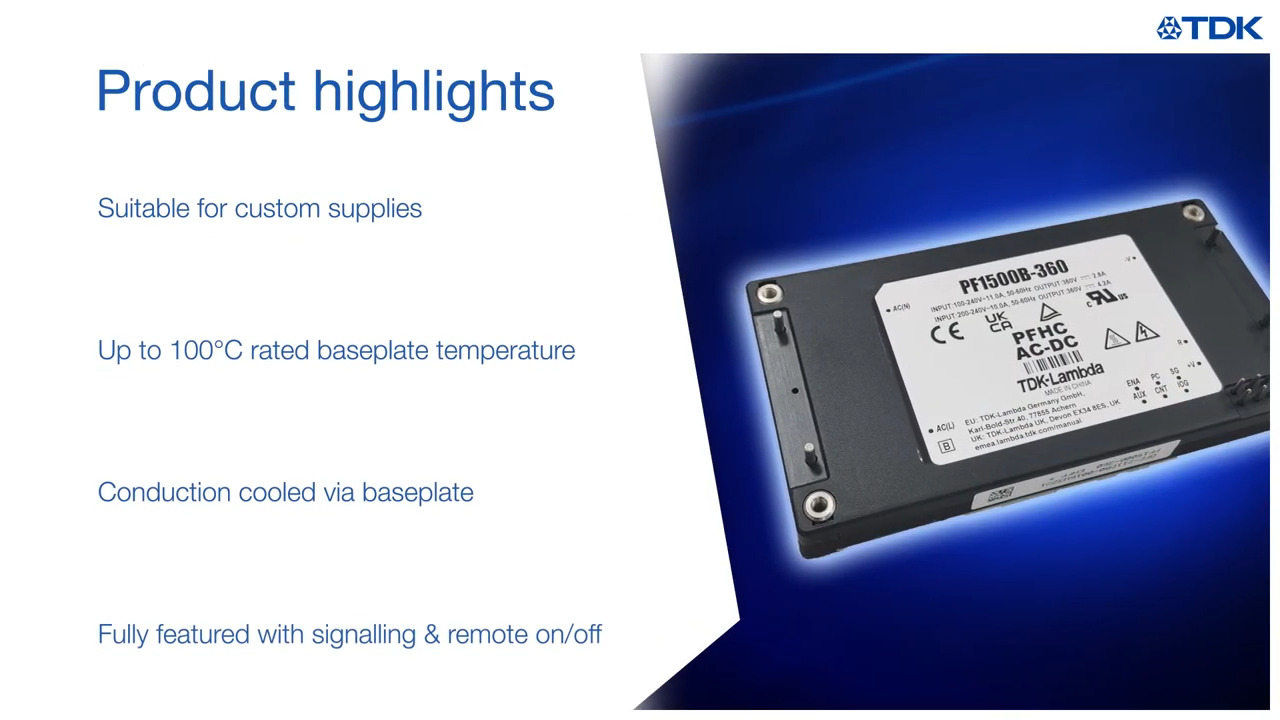
Non-isolated AC/DC: Also a full-brick size, the PF1500B-360 enclosed module converts AC input to a regulated 360 volt DC (VDC) output for use in distributed power systems that use isolated high-voltage DC/DC converters, or loads requiring a high-voltage source. It is rated at 1512 watts at 170 to 265 VAC input and 1008 watts at 85 to 265 VAC. The module has a power factor of 0.98 and an efficiency up to 96.5%.
Isolated DC/DC: The GQA2W024A050V-007-R isolated DC/DC converter delivers 120 watts in a compact and high-performance quarter-brick footprint, with up to 3000 VDC input-to-output isolation. It operates over an input range of 9 to 36 volts and delivers 5 volts at 24 A. Its mechanical packaging is available in multiple baseplate, enclosed, and potted configurations (Figure 3), supporting convection and conduction cooling via an external cold plate or heatsink.
 Figure 3: To provide designers with maximum flexibility for their overall package design and converter cooling, the GQA2W024A050V-007-R converter is available in multiple package configurations. (Image source: TDK-Lambda)
Non-isolated DC/DC: The I6A24014A033V-003-R non-isolated point-of-load (PoL) DC/DC converter is well-suited for creating high-current output-voltage rails from a 12 or 24 VDC power supply. It has an input range of 9 to 40 volts, delivers up to 14 A, and offers a wide output adjustment range of 3.3 to 24 volts in a compact 1/16th-brick package.
Conclusion
TDK Lambda offers isolated and non-isolated pc board-mountable converters for a variety of topologies and input and output voltage specifications. The result is an optimized set of high-performance, off-the-shelf converters that can meet a wide range of power configurations.
About this author

Bill Schweber is an electronics engineer who has written three textbooks on electronic communications systems, as well as hundreds of technical articles, opinion columns, and product features. In past roles, he worked as a technical web-site manager for multiple topic-specific sites for EE Times, as well as both the Executive Editor and Analog Editor at EDN.
At Analog Devices, Inc. (a leading vendor of analog and mixed-signal ICs), Bill was in marketing communications (public relations); as a result, he has been on both sides of the technical PR function, presenting company products, stories, and messages to the media and also as the recipient of these.
Prior to the MarCom role at Analog, Bill was associate editor of their respected technical journal, and also worked in their product marketing and applications engineering groups. Before those roles, Bill was at Instron Corp., doing hands-on analog- and power-circuit design and systems integration for materials-testing machine controls.
He has an MSEE (Univ. of Mass) and BSEE (Columbia Univ.), is a Registered Professional Engineer, and holds an Advanced Class amateur radio license. Bill has also planned, written, and presented on-line courses on a variety of engineering topics, including MOSFET basics, ADC selection, and driving LEDs.

Have questions or comments? Continue the conversation on TechForum, DigiKey's online community and technical resource.
Visit TechForumMore Blogs from this Author